Introduction
Among all TCT circular saw blades for woodworking, ATB is one of the most widely‑used tooth geometries. Many woodworkers buy ATB blades but do not fully understand how its bevel‑edged teeth deliver splinter‑free cross‑cut results.
ATB stands for Alternate Top Bevel. It is famous for clean cross‑grain cutting performance on solid wood, plywood and veneer panels. But ATB is not suitable for every cutting task. If you use it on ripping work or highly abrasive boards, you will get poor results and shorter blade service life.
This article explains ATB tooth structure, working principle, strengths, weaknesses, application scenarios and the difference between standard ATB and Hi‑ATB.
What Is ATB (Alternate Top Bevel) Tooth Geometry?
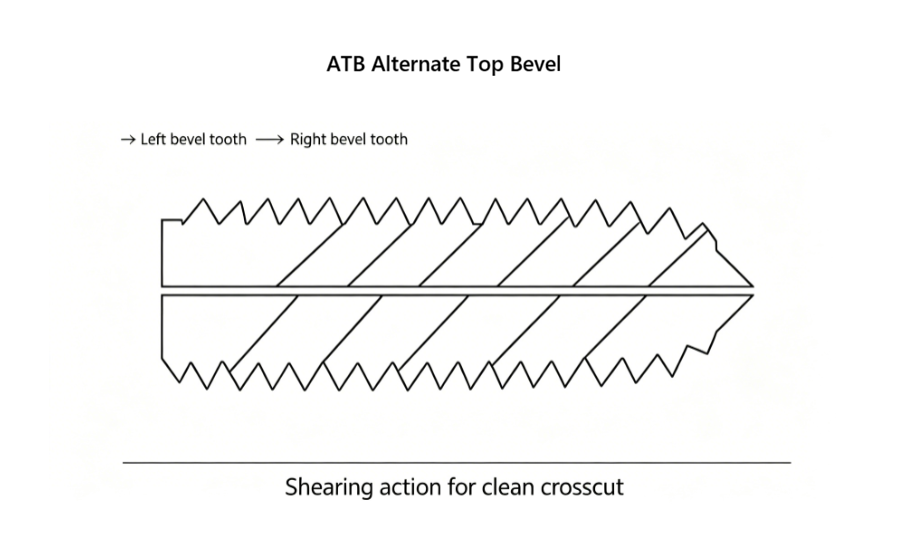
ATB means the saw blade teeth alternate between left‑hand bevel and right‑hand bevel. One tooth tilts its cutting edge to the left, the next tooth tilts to the right, repeating around the blade.
There is no flat horizontal top surface like FTG teeth. The beveled carbide tips act like a pair of scissors. Instead of smashing wood fibers, they shear fibers off during cutting.
Hi‑ATB is a variant of standard ATB. It uses larger bevel angles. Higher bevel creates sharper shearing action, which is critical for thin veneer plywood to eliminate surface tear‑out.
How Does an ATB Saw Blade Work?
When cross‑cutting wood (cutting across the grain direction):
- Left‑bevel tooth shears one side of the workpiece surface.
- Next right‑bevel tooth shears the opposite side.
- The two‑sided shearing action severs wood fibers before fibers can tear and pull away from the board face.
That is why ATB achieves smooth, splinter‑free cross‑cut surfaces.
Important note: This shearing mechanism works best for cross‑cut. When ripping along wood grain, ATB beveled teeth cannot remove chips efficiently.
Advantages of ATB Saw Blades
✅ Excellent cross‑cut finish, minimal tear‑out and splintering
✅ Works great for veneered plywood and furniture‑grade solid wood
✅ Balanced cutting performance for general woodworking shops
✅ Hi‑ATB version further improves cutting quality for thin delicate veneers
Limitations of ATB Saw Blades
❌ Not designed for ripping operations. Cutting along grain will be slow and rough.
❌ Bevel carbide edges wear relatively fast on abrasive materials such as raw MDF or particleboard. Resin inside composite boards erodes the sharp bevel corners quickly.
❌ Not recommended for melamine panels; TCG geometry is a better choice for these boards.
Best Materials for ATB Saw Blades
- Hardwood cross‑cut: oak, walnut, maple
- Softwood cross‑cut: pine, cedar, fir
- Plywood, veneered panels (use Hi‑ATB for high‑end thin veneer)
- Furniture‑grade cross‑cut joinery work
Do‑not‑use list: MDF, particleboard, melamine boards, ripping solid wood.
ATB vs Hi‑ATB: When Do You Need Hi‑ATB?
| Item | Standard ATB | Hi‑ATB |
|---|---|---|
| Bevel Angle | Medium | Larger steeper angle |
| Veneer cutting | Good | Excellent, nearly zero tear‑out |
| Wear speed | Normal | Slightly faster wear |
| Best for | General hardwood / softwood cross‑cut | Thin‑veneer plywood, high‑grade furniture |
Practical Buying & Operation Tips
- ATB blades are optimized for cross‑cut. Prepare a separate FTG blade if you often need ripping work.
- For plywood with expensive thin decorative veneer, choose Hi‑ATB instead of regular ATB.
- Avoid running ATB blades constantly on abrasive resin‑rich boards; this will blunt carbide tips rapidly.
- Tooth count selection: Higher teeth count delivers smoother surface, but lower feed speed. For general‑purpose cross‑cutting, 40‑60‑tooth ATB blades are very common.
Conclusion
ATB (Alternate Top Bevel) is the go‑to tooth geometry for clean wood cross‑cuts. Its alternating left‑right bevel teeth shear wood fibers instead of chopping them, preventing splinters and tear‑out on solid wood and plywood.
Remember its boundaries: ATB excels at cross‑cut, not ripping or abrasive composite boards. Upgrade to Hi‑ATB when you handle high‑quality veneer plywood.