Introduction
When cutting melamine, laminated or veneered panels on a sliding table saw, the most common quality problem is chipping on the bottom face — the main saw blade tears the decorative surface as it exits the material.
The industry-standard solution is a scoring saw blade that pre-cuts a shallow groove on the bottom of the panel before the main blade arrives. Among scoring blade designs, the TCT conical adjustable scoring saw blade is the most versatile because it lets you fine-tune the cutting width without changing shims or blades.
This guide explains what a conical adjustable scoring blade is, how it works, key specifications, setup procedure, common mistakes and maintenance tips.
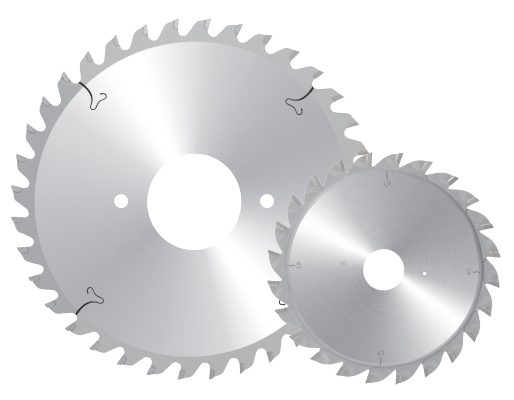
1. What Is a Conical Adjustable Scoring Saw Blade?
A conical adjustable scoring saw blade is a two-blade set designed for pre-scoring laminated panels on sliding table saws and panel sizing saws.
Components of the Set
| Component | Function |
|---|---|
| Two TCT saw blades | Each has conical (V-shaped) teeth; mounted face-to-face |
| Shim / spacer ring | Placed between the two blades to set the base cutting width |
| Arbor nut / locking mechanism | Secures the set on the scoring saw arbor |
What “Conical” Means
The teeth are ground with a V-shaped or conical profile rather than a flat top. Because of this geometry:
- Deeper cut = wider groove (the V opens wider as it penetrates)
- Shallower cut = narrower groove (only the tip of the V cuts)
This is the key advantage: you can adjust the scoring width by raising or lowering the blade, without adding or removing shims.
What “Adjustable” Means
There are two adjustment methods, often used together:
- Shim adjustment: Change the spacer between the two blades to set the base kerf (e.g., 2.8mm, 3.2mm, 3.6mm)
- Depth adjustment (conical feature): Fine-tune the width by adjusting blade height — deeper = wider, shallower = narrower
Note: Some premium systems use a dial-adjust mechanism that changes kerf in 0.1mm increments while the blade is still mounted on the machine, eliminating shims entirely.
2. How It Works: The Anti-Chipping Principle
The Problem
When a main saw blade cuts through a laminated panel from top to bottom:
- The top face is cut cleanly (teeth enter from top, shearing fibers downward)
- The bottom face chips — as teeth exit the material, they pull the laminate layer upward instead of shearing it, causing tear-out
The Solution
The scoring blade is mounted below the table, ahead of the main blade, and rotates in the opposite direction to the main blade.
- Scoring pass: The small scoring blade cuts a shallow groove (1–2mm deep) on the bottom face of the panel. This pre-severs the laminate fibers along the cut line.
- Main pass: The larger main blade follows, cutting through the full thickness. Because the bottom fibers are already pre-cut, there is nothing to tear — the edge exits clean.
Why Conical Adjustable Is Better
- Fixed-width scoring blade: One width only. If your main blade wears and gets narrower, the scoring groove becomes too wide, leaving a visible step on the cut edge.
- Conical adjustable: As the main blade is sharpened (narrower kerf), you simply raise the scoring blade slightly to make a narrower groove — matching the main blade’s new width in seconds.
3. Key Specifications
| Parameter | Common Values | Notes |
|---|---|---|
| Diameter | 120mm (most common), 125mm, 160mm, 180mm | 120mm is the industry standard for sliding table saws |
| Arbor (bore) size | 20mm, 22mm, 30mm, 45mm, 55mm | Must match your scoring saw arbor; reducer rings available |
| Teeth per blade | 12+12 (two blades), 24 total | Some models use 12+12 ATB; others use TCG |
| Tooth geometry | ATB (Alternate Top Bevel), TCG (Triple Chip Grind), KWS (conical) | ATB for wood/veneer; TCG for abrasive laminates/MDF |
| Adjustable kerf range | 2.8–3.6mm (most common), 3.6–4.4mm, 4.3–5.3mm | Must cover your main blade kerf |
| Plate thickness | 2.2mm, 3.2mm | Thinner plate = less material waste |
| Carbide tip grade | K10, K20, K30 (or equivalent) | K10 = wear-resistant for abrasive materials; K30 = tougher for nail-embedded wood |
| Steel body | 75Cr1, SKS51, German HUGO steel | 75Cr1 is industrial standard; SKS51 is premium Japanese |
| Coating | CrN (chromium nitride), PTFE, ICE coating | Reduces resin buildup and friction |
| Max RPM | 8,000–12,000 RPM | Check your scoring saw motor speed |
| Adjustment precision | ±0.05mm (shim), 0.1mm increments (dial type) | Conical depth adjustment is continuous |
Typical Specification Example
A common industrial set: 120mm diameter × 20mm bore × 2.8–3.6mm adjustable kerf × 12+12 ATB teeth × 75Cr1 body × CrN coating
4. Suitable Materials
Conical adjustable scoring blades are designed for double-sided decorative panels where bottom-face chipping is a problem:
| Material | Scoring Required? | Notes |
|---|---|---|
| Melamine faced chipboard (MFC) | Yes — essential | Most common application; both faces melamine-coated |
| High-pressure laminate (HPL / Formica) | Yes — essential | Hard, brittle surface chips easily |
| Veneered plywood / MDF | Yes — recommended | Thin veneer tears on exit |
| Laminated MDF / HDF | Yes — recommended | Both faces coated |
| Raw MDF / HDF | Optional | Less chipping, but scoring improves edge quality |
| Raw chipboard / particleboard | Optional | No decorative surface to protect |
| Solid wood | No | Solid wood does not chip on exit the way laminates do |
| Aluminum / plastic | No | Different blade type required |
Rule of thumb: If the panel has a decorative surface on both sides and you can see the cut edge in the finished product, use a scoring blade.
5. Setup and Adjustment Procedure
Step 1: Match the Scoring Kerf to the Main Blade Kerf
- Measure your main blade’s actual kerf (cutting width) with a caliper or by making a test cut
- Set the scoring blade’s base kerf (via shims) to match or be 0.1–0.2mm wider than the main blade kerf
- Example: Main blade kerf = 3.2mm → scoring set to 3.2–3.4mm
Step 2: Set the Scoring Depth
- Adjust the scoring blade height so it cuts 1–2mm deep into the bottom of the panel
- Too shallow = incomplete pre-cut, chipping still occurs
- Too deep = unnecessary wear, possible overheating
Step 3: Verify Alignment
- The scoring blade must be perfectly aligned with the main blade in the cutting direction
- Any lateral misalignment causes a step or double groove on the cut edge
Step 4: Test Cut and Fine-Tune
- Make a test cut on a scrap piece of the actual panel
- Inspect the bottom edge: no chipping, no visible scoring line beyond the cut
- If chipping remains → scoring depth too shallow or kerf too narrow
- If a visible groove remains on the cut face → scoring kerf too wide → raise the blade (conical adjustment narrows the cut)
Step 5: Re-adjust After Main Blade Sharpening
- Every time you sharpen the main blade, its kerf gets slightly narrower
- Re-check and re-adjust the scoring blade height (conical feature makes this quick)
6. TCT vs PCD Scoring Blades
| Feature | TCT (Tungsten Carbide Tipped) | PCD (Polycrystalline Diamond) |
|---|---|---|
| Tip material | Sintered tungsten carbide | Polycrystalline diamond |
| Lifespan | 1–3 months (typical production) | 1–3 years (20–50x longer) |
| Cost per blade | Low ($15–$60 per set) | High ($150–$500 per set) |
| Cost per cut | Higher (frequent replacement) | Lower (amortized over long life) |
| Sharpness retention | Good, degrades gradually | Excellent, stays sharp very long |
| Best for | Small-to-medium production, varied materials, budget-conscious | High-volume production, same material daily, precision-critical |
| Re-sharpening | Yes, can be re-sharpened 5–10 times | Requires specialized diamond grinding; limited re-sharpening |
Recommendation: For most furniture factories and cabinet shops, TCT is the practical choice. For high-volume panel sizing lines running 2+ shifts daily, PCD pays for itself in reduced downtime and blade changes.
7. Common Mistakes
Mistake 1: Scoring kerf too narrow
- Symptom: Bottom face still chips
- Fix: Lower the scoring blade (conical = deeper cut = wider kerf) or add a thicker shim
Mistake 2: Scoring kerf too wide
- Symptom: Visible groove or step on the cut edge; the scoring line extends beyond the main cut
- Fix: Raise the scoring blade (shallower cut = narrower kerf) or use a thinner shim
Mistake 3: Scoring depth too deep
- Symptom: Excessive noise, overheating, premature blade wear, possible burning
- Fix: Reduce depth to 1–2mm; scoring only needs to penetrate the decorative layer
Mistake 4: Misalignment between scoring and main blade
- Symptom: Wavy cut edge, double groove, one side of cut has chipping
- Fix: Realign the scoring saw fence; check arbor runout; ensure both blades are parallel
Mistake 5: Using a scoring blade for solid wood
- Symptom: No benefit; unnecessary cost and setup time
- Fix: Scoring blades are for laminated/veneered panels only. Solid wood cuts clean without pre-scoring.
Mistake 6: Ignoring scoring blade sharpness
- Symptom: Chipping returns gradually; scoring groove becomes rough
- Fix: Re-sharpen or replace scoring blades on the same schedule as main blades. A dull scoring blade causes chipping just as a dull main blade does.
8. Maintenance Tips
- Clean after each shift: Remove resin and pitch buildup with blade cleaner or citrus-based solvent. Buildup increases friction and heat.
- Check runout monthly: Mount on a mandrel and use a dial indicator. Lateral runout should be under 0.10mm.
- Store properly: Hang on a peg or store in original packaging — do not stack blades on top of each other (damages teeth).
- Re-sharpen before fully dull: A blade that is slightly dull is cheaper to re-sharpen than one with chipped or broken carbide tips.
- Inspect carbide tips: Look for cracks, chips or missing tips. A cracked tip can fail catastrophically at high RPM.
- Check the arbor: A worn scoring saw arbor causes runout — replace the arbor bearing if play is detected.
- Match feed speed: Too fast = chipping and overheating; too slow = burning. Follow the blade manufacturer’s recommended feed rate for your material.
9. Conclusion
A TCT conical adjustable scoring saw blade is an essential tool for chip-free cutting of melamine, laminated and veneered panels on sliding table saws. Its conical tooth geometry allows continuous width adjustment by simply changing blade height, making it easy to match the main blade’s kerf — even as the main blade wears and is sharpened.
The key to success is three things:
- Match the scoring kerf to the main blade kerf (±0.1–0.2mm)
- Set scoring depth to 1–2mm (just through the decorative layer)
- Re-adjust after every main blade sharpening
Get these right, and you will consistently produce clean, chip-free edges on every panel — reducing rework, waste and customer complaints.
Need TCT Conical Adjustable Scoring Blades?
Badatools supplies industrial-grade TCT conical adjustable scoring saw blade sets in 120mm, 125mm, 160mm and 180mm diameters, with adjustable kerf ranges from 2.8mm to 5.3mm. All sets use 75Cr1 steel bodies, K10/K20 carbide tips and CrN coating. Custom bore sizes and tooth geometries available.